Gantry Machining Centers Explained: Structure and Uses
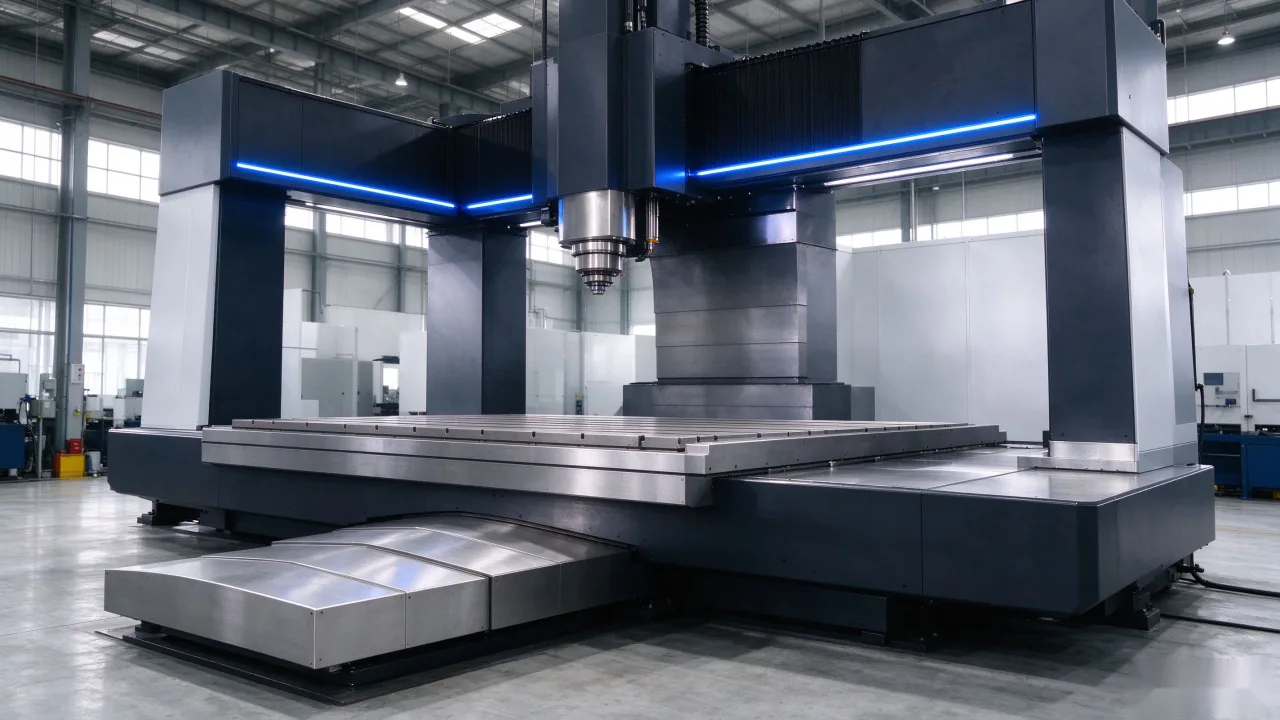
How a gantry machining center differs from a column-type VMC, why the design stays stiff on large parts, and typical applications.
A gantry machining center carries the spindle between two uprights joined by a crossbeam, either fixed with a moving table or travelling over a fixed table. Either way, the cutter is supported by a closed loop of cast iron instead of a cantilevered column. That is why gantries hold flatness across parts several metres long where a conventional VMC would start to deflect.
Why the Gantry Stays Accurate
Both uprights share the load, so the spindle sits between two supports rather than hanging off one side. Thermal growth is symmetric and easier to compensate, and wide guideway spacing resists the pitching moments that large cutters generate.
- Fixed gantry with moving table: common up to 3 to 4 m X-travel, easiest to keep accurate.
- Moving gantry with fixed table: for very large or heavy workpieces.
- Dual drives on each upright keep the beam square at speed.
Typical work includes machine tool beds, welded frames, large mould bases and long aluminium components. If your parts are wider than about one metre or longer than two, a gantry usually pays for itself in setups saved.
Talk to VITOP Machinery
Questions about this topic or your upcoming project? Email vitopmachinery@163.com or message us on WhatsApp: +86 183 1908 0212. Browse all machines at www.vitopmachinery.com. We reply within one business day.