How to Choose CNC Machines for Mould and Die Making
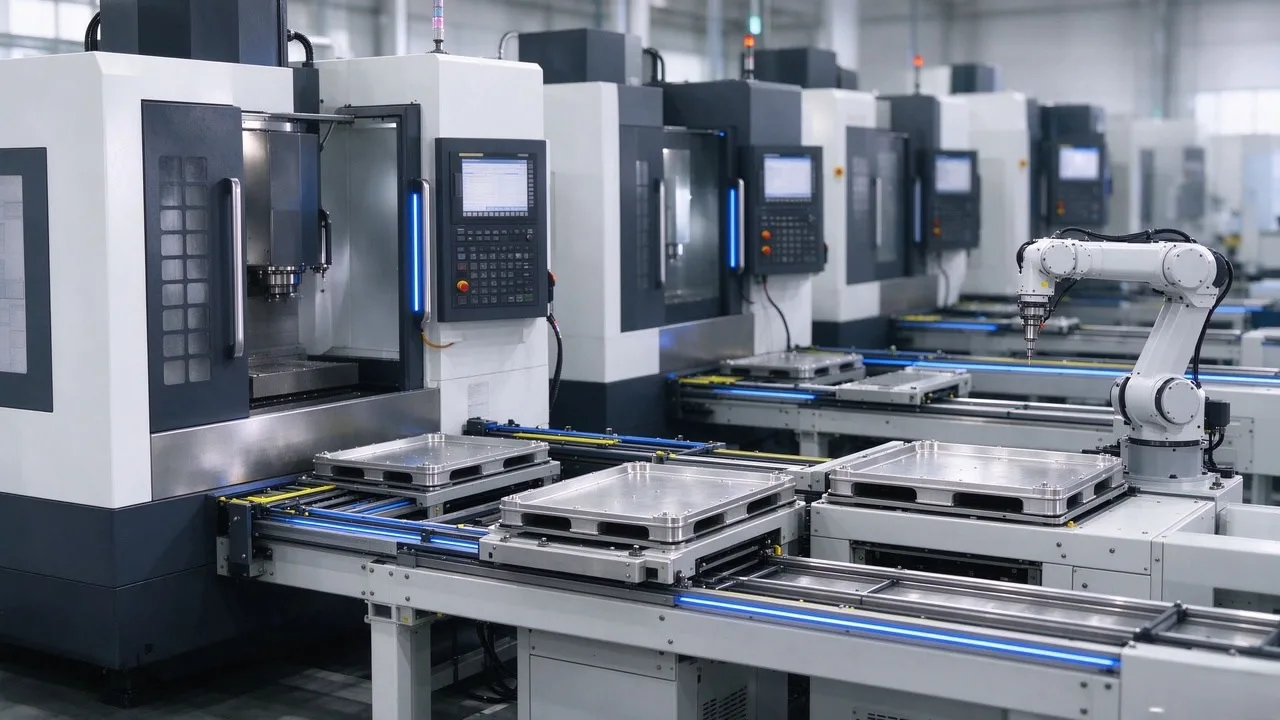
The mould machining chain from roughing VMC to EDM and surface grinding, the accuracy to ask for, and when a gantry machining center is needed for large moulds.
Setting up or upgrading a mould shop is one of the most demanding equipment decisions in machining, because moulds combine hard materials, deep cavities and tight tolerances in a single part. The mistake we see most often is buying one machine to do everything. A well-planned mould shop is a chain of machines, each doing the stage it is best at. Here is how that chain fits together and what to specify at each step.
The Typical Mould Machining Chain
A plastic injection mould or die stamping tool moves through four stages, and each stage points to a different machine:
- Roughing the cavity and core block.
- High-speed finishing of 3D surfaces.
- EDM for sharp corners, ribs and details the cutter cannot reach.
- Surface grinding of clamping and reference faces.
Roughing: A Rigid VMC with Real Spindle Power
Roughing removes most of the metal from a mould block, often on pre-hardened P20 or 718 steel. This stage needs rigidity and torque more than speed. A box way vertical machining center with a geared or high-torque spindle, good damping and a solid HT300 casting will take deep, wide cuts without chatter and will hold its geometry for years of this work. Look at table size against your biggest block, Z-axis clearance for deep cavities, and through-spindle coolant for deep drilling.
High-Speed Finishing: Small Tools, Fast Moves
After heat treatment or on the semi-finished block, finishing passes with 2-6 mm ball nose cutters trace the 3D surfaces. This is the opposite requirement: fast acceleration, high spindle speed and smooth contouring. A linear guideway machining center with a 12,000-15,000 rpm or higher spindle and a capable CAM post-processor will cut finishing time dramatically compared with a heavy roughing machine. Many mould shops keep two machines: one roughing, one finishing. The finishing machine's output quality decides how much hand polishing your mould makers do later.
EDM for Cores, Cavities and Details
Internal corners sharper than the smallest cutter, deep narrow ribs, textured surfaces and hardened details go to EDM. Sinker EDM machines electrodes into cavities; wire EDM cuts through-hardened inserts and punch shapes with precision. For a mould shop, at least one EDM machine is not optional, because no milling cutter reaches every feature. Plan electrode production too: a small high-speed milling machine or engraving-milling machine making graphite and copper electrodes keeps the EDM fed.
Surface Grinder for Clamping Plates
Mould plates clamp and locate against ground faces. If the clamping plates and reference surfaces are not flat and parallel, errors transfer into the assembled mould no matter how accurately the cavities were cut. A surface grinder is one of the cheapest machines in the shop and one of the most used. Grinding mould plates and slide faces flat before milling, and finishing them after heat treatment, is standard practice in every serious mould factory.
Accuracy You Should Ask For
Mould work lives on positioning accuracy, repeatability and thermal stability. In practical terms, ask suppliers for measured results, not brochure hopes: positioning and repeatability verified by laser interferometry, and circularity or contouring performance verified by ballbar testing. Every machine VITOP Machinery ships is laser-verified with interferometry and ballbar testing before delivery, and we send the results with the machine. Also ask how the castings are stabilised; our HT300 resin-sand castings go through double ageing treatment so the geometry does not drift during the machine's first year. On the shop floor in a warm climate, keep the machines away from direct sun and supply stable power, because thermal drift hurts finishing accuracy more than most buyers expect.
Large Moulds Need a Gantry Machining Center
When the mould grows past roughly a metre across, automotive bumpers, home appliance panels, large pallets and die sets, a C-frame VMC runs out of table and Y-axis travel. A gantry machining center solves this: the column moves across a fixed table, so travel can be extended without a huge moving mass, and the bridge structure stays rigid under heavy cuts across a wide table. For large mould shops, a gantry machine for roughing plus a VMC or high-speed machine for detail work is the common layout. VITOP Machinery manufactures gantry machining centers as one of our core series, including BT50 versions that accept right-angle heads for machining side faces and deep internal features in one setup.
A Practical Starting List
- One box way VMC for roughing, sized to your largest block.
- One linear guideway, high-speed machine for finishing and electrodes.
- One sinker EDM and, when inserts and through cuts appear, one wire EDM.
- One surface grinder for plates and reference faces.
- A gantry machining center when your moulds exceed the VMC's travels.
Build the chain step by step as orders justify it, but keep the stages in mind from day one so your first machine is not the wrong one. VITOP Machinery has spent more than 13 years supplying mould and die shops worldwide from our 30,000 m2 production base, with casting, precision machining, assembly and inspection under one roof and full OEM/ODM support. Send us your typical mould sizes and materials, and we will propose the machine chain that matches your budget.
Talk to VITOP Machinery
Planning a machine purchase or need help matching a model to your parts? Send your drawings or questions to vitopmachinery@163.com, or message us directly on WhatsApp: +86 183 1908 0212. You can also browse all machines at www.vitopmachinery.com. We reply within one business day.