5-Axis Machining Centers: Impellers, Blades, Complex Surfaces
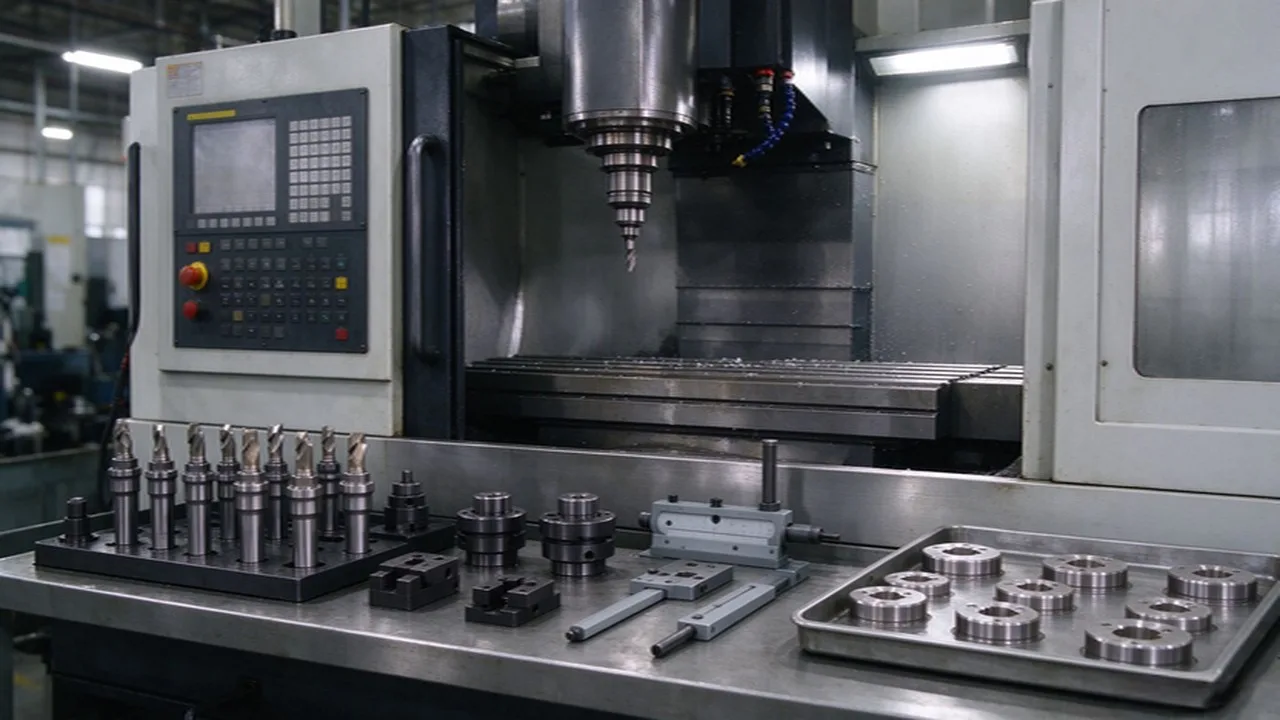
Where a 5-axis machining center earns its price, what impeller plus complex-surface work demands from the machine, plus how to judge builders.
If your parts list includes impellers, blisks, turbine blades or any surface that curves in two directions at once, a 3-axis machine with a rotary table bolted on will only take you so far. A true 5-axis machining center moves three linear axes and two rotary axes under simultaneous control, and that changes what you can hold in tolerance, how long your tools last and how many setups a part needs.
What 5-Axis Actually Changes on the Floor
Two modes matter. In 3+2 positioning, the rotary axes index the part to an angle, lock, and the machine cuts as a 3-axis mill. That solves access problems on complex parts and lets you use shorter, stiffer tools. In continuous 5-axis, all five axes move together so the tool stays tangent to the surface. Impeller work demands the continuous mode, because a blade surface twists along its whole length and a fixed-angle setup would leave scallops you then have to blend by hand.
Continuous 5-axis also cuts cycle time on multi-face parts. A housing that needs features on five faces can often finish in one setup instead of three or four. Fewer setups mean fewer datum errors stacking up, and datum error is usually where tolerance dies.
Impellers, Blisks and Blades
An impeller for a pump, blower or turbocharger combines twisted blades, narrow passages and a hub that blends into both. To cut the passage, the swivel head or trunnion must tilt far enough for the tool to reach between blades without the holder colliding. Most impeller cutting runs tools under 16 mm diameter, so rotary axis rigidity and motion smoothness matter more than raw spindle power. Ask the builder how the rotary axes are driven and clamped, and request a test cut on a passage similar to yours.
For aerospace brackets and structural parts the gain is different: one setup for a part that would otherwise be flipped repeatedly, plus smoother tool engagement that reduces thin-wall distortion.
Complex Surfaces Beyond Aerospace
Mould shops use 5-axis for deep cavities, where a short tool held at an angle reaches walls a straight tool cannot. Medical shops cut implants and bone plates in a single setup. Reflector and lens moulds need the surface finish that only continuously controlled tool contact produces. If your work sits in any of these categories, the machine pays for itself through setup reduction before you even count the finish gains.
What to Inspect in the Machine Itself
- Rotary axis construction: torque motor or worm drive, backlash control, and trunnion clamping force for heavy parts.
- RTCP quality: tool centre point control keeps the tool tip on path while the head swivels; poor RTCP shows up as waviness on curved surfaces.
- Accuracy grade: standard vertical machines hold about ±0.01-0.02 mm positioning; precision grade is ±0.005 mm. Ask for the ISO 10791-series geometric test report of the actual machine you are buying, not a brochure.
- CAM support: confirm your post-processor and simulation software handle the control before you order.
What 5-Axis Costs in 2026
Trade listings put 5-axis machining centers at roughly USD 100,000-300,000 FOB depending on size, table load and control package. Japanese and German builders still hold about 52% of the high-end 5-axis and high-rigidity segment in Southeast Asia, but Chinese manufacturers have advanced quickly in the entry and midrange band, and that is where most first-time 5-axis buyers actually land. At VITOP, our 5-axis line targets impellers, aerospace components and complex surfaces, backed by in-house casting, machining and assembly in our 30,000 m2 Guangdong base.
Prove It Before You Pay
Send the supplier your hardest part drawing and ask for a sample cut, filmed with the fixture and machine in frame. Ask for the ballbar and laser interferometry results of your machine. For a large order, witness the test in person or through a third-party inspector. A builder with nothing to hide will say yes to all three.
Talk to VITOP Machinery
Planning a machine purchase or need help matching a model to your parts? Send your drawings or questions to vitopmachinery@163.com, or message us directly on WhatsApp: +86 183 1908 0212. You can also browse all machines at www.vitopmachinery.com. We reply within one business day.
Need a CNC Machine for Your Project?
Tell us what you need to machine — our engineers will recommend the right model and send a quotation within 24 hours.