Bumper Mould Manufacturing: Cutting Large Tooling Well
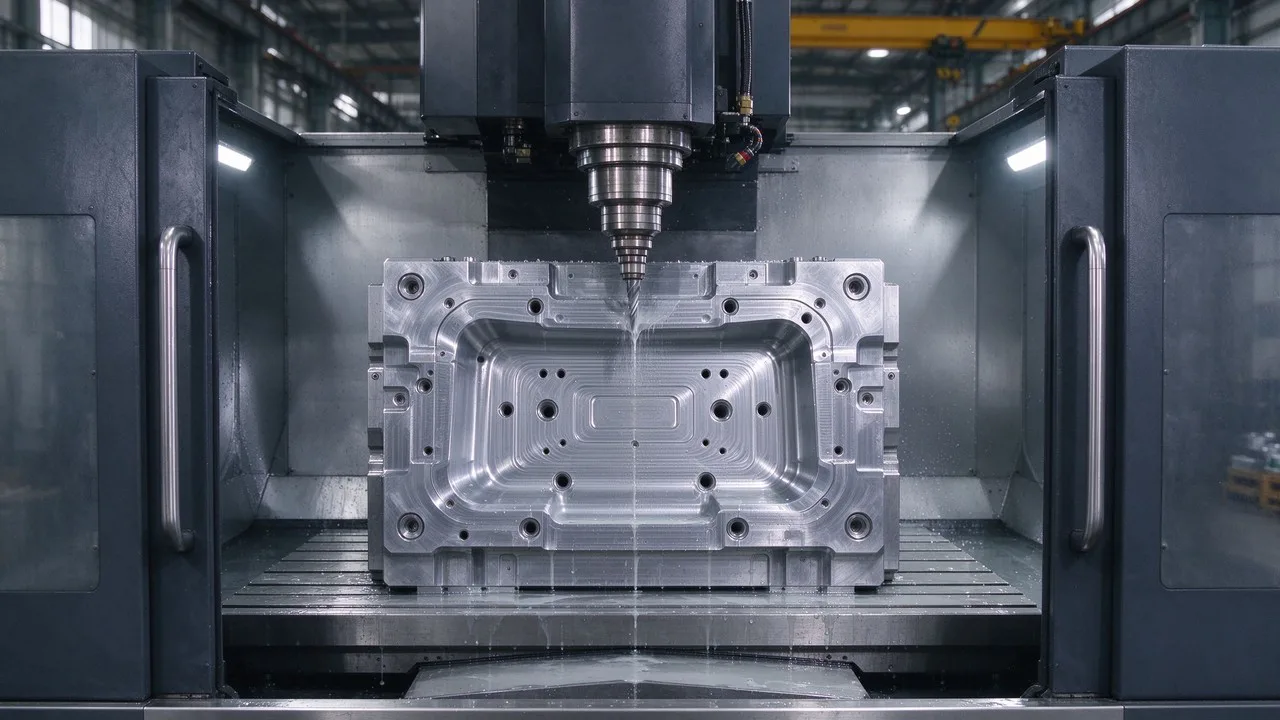
A bumper mould is one of the largest injection tools in a car. What it takes to machine one: size, surface finish, and the gantry equipment behind it.
A front or rear bumper mould is among the biggest injection tools made for a car - typical mould plates run 2.5 to 4 metres long and weigh several tonnes. The visible surface must come out class-A smooth, because buyers see it every day. Cutting one well is a gantry machine job, and getting it right depends on a handful of practical decisions.
Why bumper tooling needs a gantry
The mould core alone usually exceeds the table of a standard vertical machining center. A gantry machining center with clear spans of 2.5 to 4 metres between columns lets the whole core sit inside the working envelope. More importantly, a gantry carries heavier heads and takes deeper cuts in the P20 or 718H steels commonly used for bumper tooling, which shortens roughing time by a wide margin compared with a light machine.
Roughing: remove the bulk honestly
Most of the machining hours on a bumper mould go into roughing out deep pockets and the general shape. The practical targets are stable heavy cuts and constant tool pressure. A geared spindle with strong low-speed torque, rigid boring or shoulder heads, and a machine casting that does not deflect are what keep the operation predictable across a multi-day roughing cycle.
Finishing the visible surface
The Class-A side is finished with long-reach ball-nose tooling in fine stepovers, often with a right-angle head to reach walls and mounting bosses near the edges. Surface defects here do not hide: any witness line from a re-clamp, any chatter band from a vibrating overhang, shows up on the painted bumper. This is why die shops separate roughing and finishing machines, and why spindle health matters more on the finishing machine than anywhere else in the shop.
Coolant, chips and housekeeping
Bumper cores generate an enormous volume of chips. Through-spindle coolant, high-pressure external wash and an automatic chip conveyor are not luxuries at this scale - they are what keeps chips from being re-cut and marring the cavity. Plan the coolant filtration before the machine arrives, not after the first surface defect.
Verify before the mould ships
A bumper mould that is geometrically off by a fraction of a millimetre shows up as a flow line or a gap against the mating panel. Our machines are laser-verified with interferometry and ballbar testing on the floor before delivery, so positioning and circularity errors are known quantities before the tool is ever cut.
Talk to VITOP Machinery
We build and customise gantry machining centers sized for bumper and fascia tooling, with OEM / ODM options for travels, spindles and controls. Describe your typical mould sizes to vitopmachinery@163.com or WhatsApp +86 183 1908 0212. Full machine range at www.vitopmachinery.com.
Need a CNC Machine for Your Project?
Tell us what you need to machine — our engineers will recommend the right model and send a quotation within 24 hours.