HMC vs Drilling-Tapping Center: When Each Fits
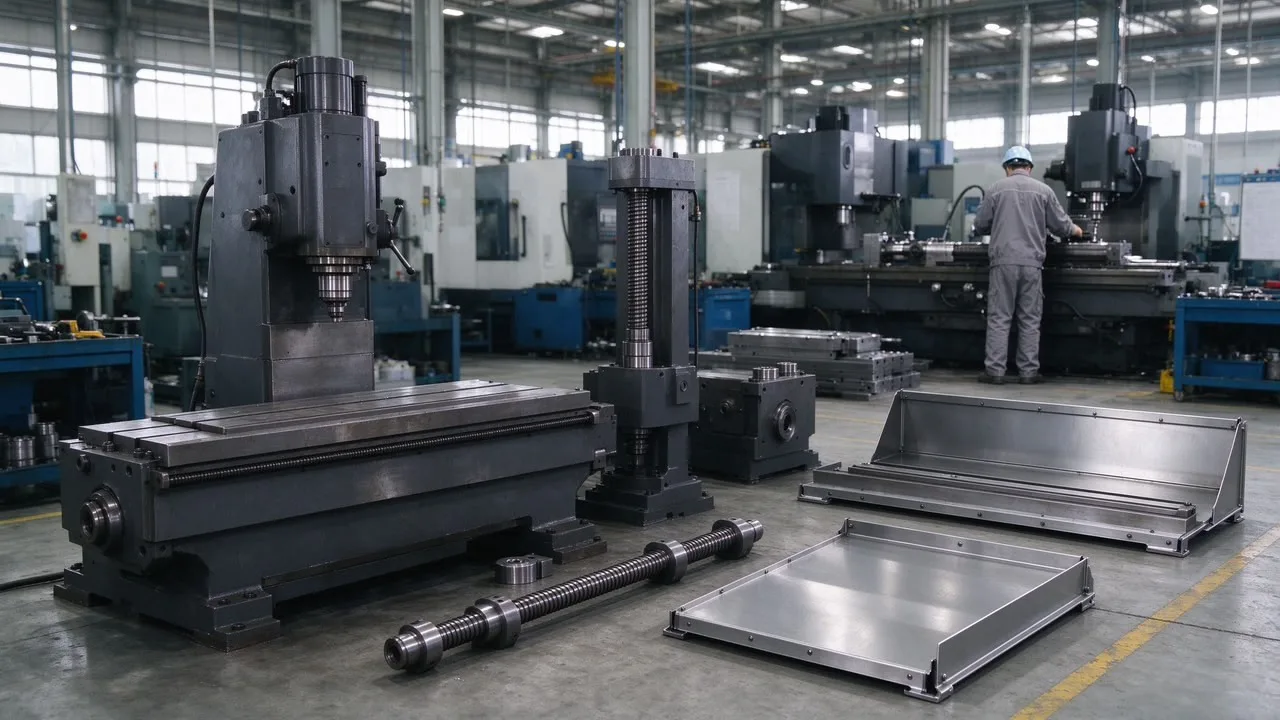
HMC or drilling-tapping center? Compare multi-face box part machining on a horizontal machining center with high-speed 3C drilling and tapping work.
Both machines cut holes and faces, but they sit at opposite ends of the production spectrum. A horizontal machining center earns its keep on heavy multi-face parts; a drilling-tapping center wins on light, fast, high-volume hole work. Choosing wrong costs either capability or money. Here is how the two VITOP lines compare.
HMC Series: Multi-Face Machining in One Setup
The horizontal machining center line runs nine models from the HMC-630 to the HMC-1814L. X-axis travel spans 800 to 2000 mm, Y from 550 to 1400 mm and Z from 550 to 1200 mm, with worktables from 630 x 630 mm up to 2000 x 900 mm and loads from 500 to 3000 kg. Spindles come in BT50-Φ190, BT40-Φ150 and BT50-Φ155 versions running 6000 or 8000 rpm with 12000 rpm optional, powered by 11 to 18.5 kW motors. The HMC-630 illustrates the design: an inverted T structure with a 630 x 630 pallet (800 x 800 optional), 1200 mm of X travel, worktable division down to 0.001 degree, FANUC 0i-MF control, BT50-Φ190 spindle at 6000 rpm, a 24-tool magazine expandable to 40, and ±0.003/300 mm repeatability on a 9500 kg machine.
What the horizontal orientation buys you: gravity drops chips away from the cut, four sides plus the top machine in one clamping, and pallet systems let you load the next part while the current one cuts. Gearboxes, pump housings, manifold blocks and structural brackets are the classic work.
VTC Drilling-Tapping Centers: Speed on Small Parts
The drilling-tapping center line covers three models, VTC-600 to VTC-700, built around a different brief: maximum holes per minute on small and medium parts. The VTC-600 carries a 700 x 420 mm worktable with 250 kg load, travels of 600 x 400 x 350 mm, and a BT30 spindle reaching 20000 rpm with an electric spindle option at 5.5 kW. Rapid traverse hits 48000 mm/min and cutting feed runs to 15000 mm/min, with a 21-tool magazine keeping the cycle moving. Controls are Mitsubishi M80VB or Syntec, positioning accuracy holds ±0.003/300 mm with ±0.002/300 mm repeatability, and the whole machine weighs just 2800 kg, which keeps freight and foundation costs low.
This class of machine dominates 3C electronics parts, small aluminium components, brackets and plate work where most operations are drilling, tapping and light milling.
Side by Side
| Factor | HMC-630 class | VTC-600 class |
|---|---|---|
| Taper | BT50 | BT30 |
| Spindle speed | 6000 rpm | 20000 rpm |
| Pallet / table | 630 x 630 mm, 1200 kg | 700 x 420 mm, 250 kg |
| Part type | Box-type, multi-face, heavy | Small, light, hole-dense |
| Chip handling | Gravity drop, horizontal cut | Vertical spindle, flush needed |
| Machine weight | 9500 kg | 2800 kg |
Workholding, Pallets and Shop Planning
Beyond cutting data, plan the surrounding systems. On the HMC-630, the inverted T structure keeps the spindle and pallets on one rigid base, and worktable division down to 0.001 degree means indexed faces machine to position without secondary alignment. Tools can reach 15 kg each, and the 24-tool magazine extends to 40 when part families run wide. Pallet load of 1200 kg with 800 x 800 tables optional gives room for tombstone fixtures that multiply part count per cycle. On the VTC side, check the physical footprint as carefully as the travels: the machine measures roughly 1700 x 2350 x 2500 mm, so two VTCs fit in the floor space one HMC occupies, with T-slots of 3-14x125 for quick vise layouts. Foundations and freight also differ; a 9500 kg horizontal machine needs a proper foundation and heavier transport, while the 2800 kg VTC often moves on a standard truck and sets down fast.
How to Decide
Ask three questions. First, does the part need machining on four or more faces with heavy sections? If yes, the HMC removes two or three setups. Second, is the work mostly holes in material under about 10 mm thickness at high volume? Then the VTC will out-cycle almost anything. Third, what comes next? Shops feeding assembly lines often pair both: VTCs for the small brackets and covers, one HMC for the housings that tie the product together. Send us your part family list and batch sizes, and we will tell you honestly which line, or which combination, fits.
Talk to VITOP Machinery
Planning a machine purchase or need help matching a model to your parts? Send your drawings or questions to vitopmachinery@163.com, or message us directly on WhatsApp: +86 183 1908 0212. You can also browse all machines at www.vitopmachinery.com. We reply within one business day.
Need a CNC Machine for Your Project?
Tell us what you need to machine — our engineers will recommend the right model and send a quotation within 24 hours.