Linear Scales on CNC Machines: When Closed-Loop Feedback Pays
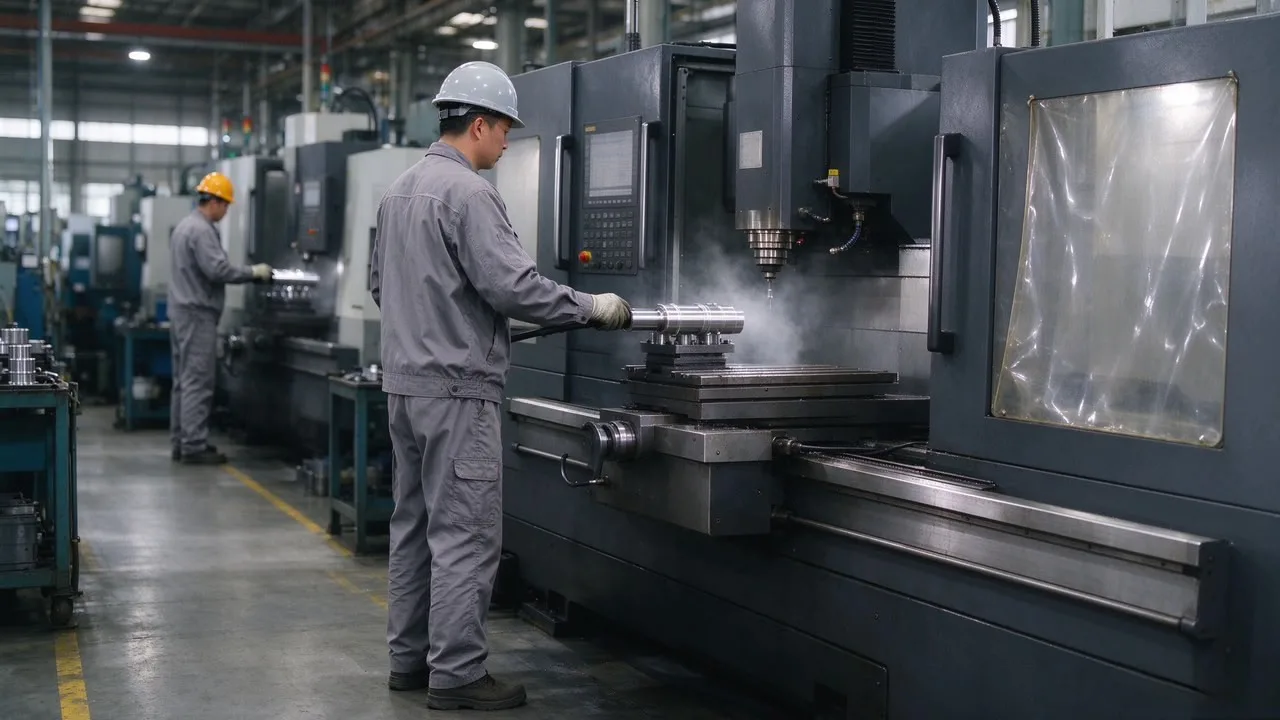
Linear scales measure the table position directly instead of through the ball screw. Where closed-loop feedback pays off: thermal drift, heavy cutting loads, tight tolerances.
Most CNC machines run semi-closed loop: the control commands an axis motor, the motor turns a ball screw, and the encoder on the motor reports rotation. The control assumes the screw pitch converted rotation into exactly the commanded linear motion. On a well-built machine that assumption mostly holds, but not always. A linear scale closes the loop for real: a grating ruler bolted along the axis measures actual table position and feeds it straight back to the control. VITOP offers linear scales as an optional accessory on all three axes, and the interesting question is when the option earns its money.
What the Scale Fixes
Three error sources disappear when the feedback moves from motor to table:
- Ball screw pitch error and wear. Every screw has small manufacturing pitch deviations, and wear concentrates on the mid-travel zones. A scale measures where the table actually is, error source irrelevant.
- Thermal growth. A long steel screw heats up during fast cycles and grows along its length. On a 3000 mm axis, a few degrees of screw temperature shift position by hundredths of a millimetre, enough to matter on precision work. The scale reads the true position regardless.
- Lost motion under load. Heavy cuts push the table against its drives; any compliance between motor and table shows up in the measurement instead of hiding in the workpiece.
When to Specify Linear Scales
The option pays in four situations. First, long travels: on gantry machines with X travel of 3000 mm and beyond, up to the 8200 mm available in the S series, screw growth and pitch error accumulate over distance, so closed-loop feedback protects the ±0.003/300 mm repeatability class across the full envelope. Second, high ambient temperature: buyers in tropical climates run shops where machine temperature swings far exceed an air-conditioned Japanese standard, and screw thermal behavior is the first casualty. Third, precision-grade work: when your tolerance band sits near the machine's positioning accuracy specification, you want measurement at the table, not an estimate at the motor. Fourth, heavy or unbalanced loads on one axis, where drive compliance would otherwise appear as dimensional drift between warm-up and steady state.
When Semi-Closed Loop Is Enough
Honest answer: for a large share of work, it is. A standard VMC with 550 to 800 mm travels, running batch parts to tolerances of ±0.02 mm, gains little from scales because screw error at those lengths stays inside the tolerance band. Every VITOP machine is already laser-verified with laser interferometry and ballbar testing before shipment, which catches and compensates systematic errors on the standard configuration. The scale buys you immunity against change over time and against environment, not against a factory defect that verification already removed.
Practical Specification Notes
If you order scales, a few details matter. Scales must be protected: ask how the units are sealed against coolant mist and swarf, especially on Z axes where chips fall onto the scale housing. Ask which axis positions the readheads use and confirm the control supports full closed-loop mode natively. On inspection day, request the laser interferometry report for the actual machine, and if scales are fitted, ask to see the closed-loop verification rather than the semi-closed one. And budget for the environment too: a scale cannot compensate a machine standing on an unstable foundation, so foundation and levelling still come first.
A Simple Decision Rule
Order linear scales when travels are long, tolerances are tight, heat is real, or the machine will run unattended for years. Skip them for standard short-travel batch work and spend the budget on tooling. If you describe your part tolerances and workshop conditions, we will tell you plainly whether the option is worth it on your model, and quote it factory-fitted and verified if so.
Talk to VITOP Machinery
Planning a machine purchase or need help matching a model to your parts? Send your drawings or questions to vitopmachinery@163.com, or message us directly on WhatsApp: +86 183 1908 0212. You can also browse all machines at www.vitopmachinery.com. We reply within one business day.
Need a CNC Machine for Your Project?
Tell us what you need to machine — our engineers will recommend the right model and send a quotation within 24 hours.